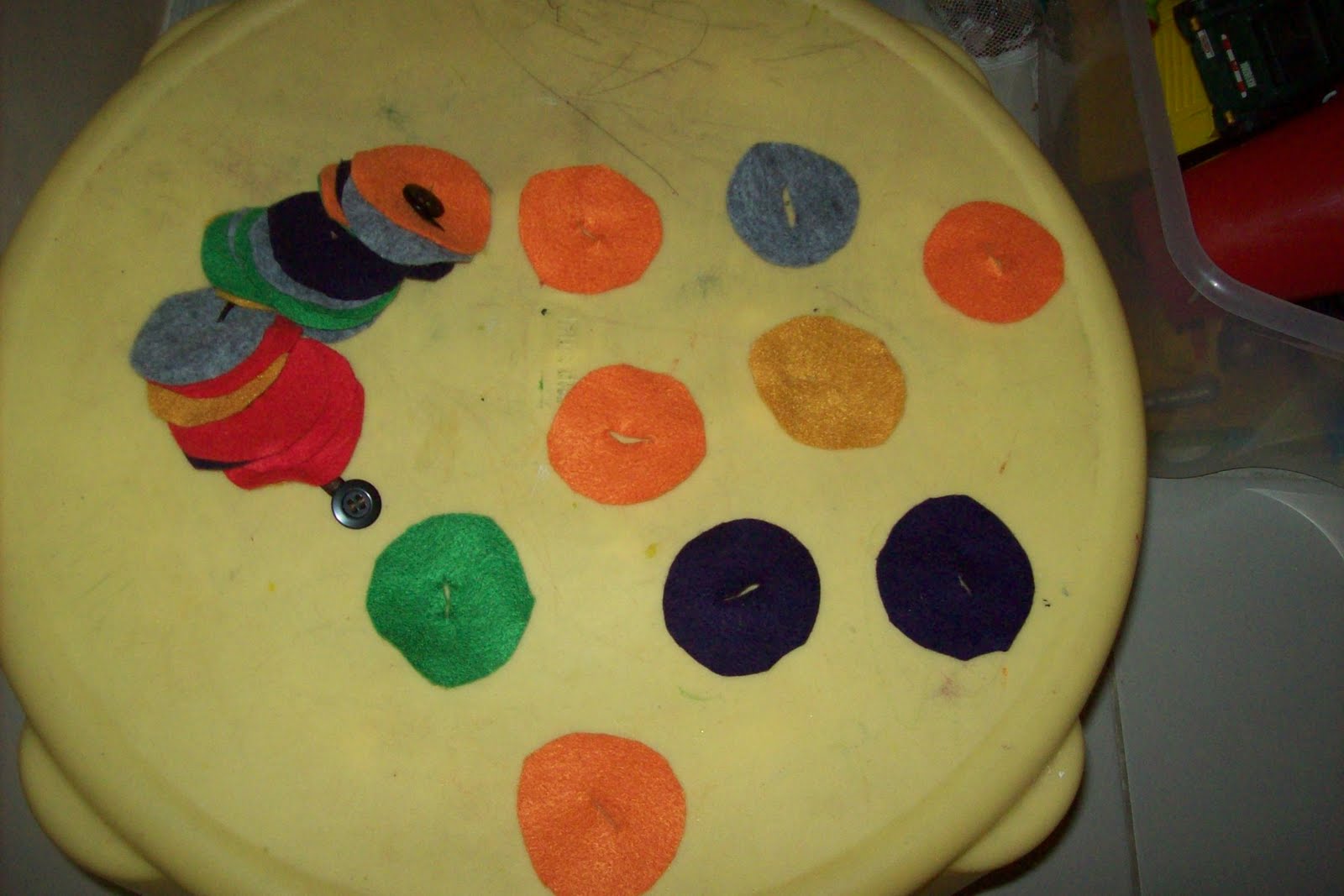
I first got this awesome idea from a blog i recently started visiting. It's a felt snake...or caterpillar, which i thought it looked more like. He's made from ribbon, and buttons sewn on each end. The purpose of this toy, besides being fun, it's a great way to get those little fingers to practice buttoning!
We took lei to the $2 store today, and of course, he saw a toy that he "really, really liked". We gave in and got it for him, but i have been trying to limit his toys lately. Not because i'm a mean mommy, but because he really, really doesn't need all of them! And, i will admit, he does like this new toy. It's a helicopter, which is right up his rescue loving alley. So, i'm pretty sure he will play with it a lot...until it breaks in a few days.
On our way home, we made another stop, and while waiting in the car i read a little about Lei's new toy. I checked to see were it was made (China), and there in nice, little writing it said "Product contains xyz (can't remember exactly what it said, but it was weird), lead, some type of phthalate, and a few other words. Known to cause cancer, birth defects, and reproductive harm.
WHAT???
Why are these toys on the market? I turned to Lei and said. "Um, honey, i don't think this toy is a very good toy to play with" Of course he want's to know why, and i tell him. And, he promises me he won't eat it. My sweet little boy. I'll let him play with it for now, knowing it won't last long, and if it does, it just may have to disappear mysteriously.
I had told my self before i was only going to buy the boys eco friendly, green toys whenever they even got toys...i really think i need to stick to that.
Here is a list of green, eco friendly, non toxic toys. All of them are from Amazon and reallyreasonably priced, which along with keeping my kids safe, is also important to me!
“Imagine for a moment that you are visiting a plant nursery. You hear a commotion outside, so you investigate. You find a young assistant struggling with a rose bush. He is trying to force open the petals of a rose, and muttering in frustration. You ask him what he is doing, and he explains, “My boss wants all these roses to bloom this week, solast week I taped all the early ones, and now I’m opening the late ones.”
You protest that every rose has it’s own schedule of blooming; it is absurd to try to slow down or speed this up; it doesn’t matter when roses bloom; a rose will always bloom at its own best time. You look at the rose again, and see that it is wilting. But when you point this out, he replies, “Oh, too bad, it has genetic dysbloomia. I’llhave to call an expert.”
“No, no!” you say, “you caused the wilting! All you needed to do was meet the flowers’ needs for water and
sunshine, and leave the rest to nature!” You can’t believe this is happening. Why is his boss so unrealistic and uninformed about roses?
Yet children are no different than roses in their development: they are born with the capacity and desire to learn, they learn at different rates, and they learn in different ways. If we can meet their needs, provide a safe, nurturing environment, and keep from interfering with our doubts, anxieties, and arbitrary timetables, then- like roses- they will all bloom at their own best time.”